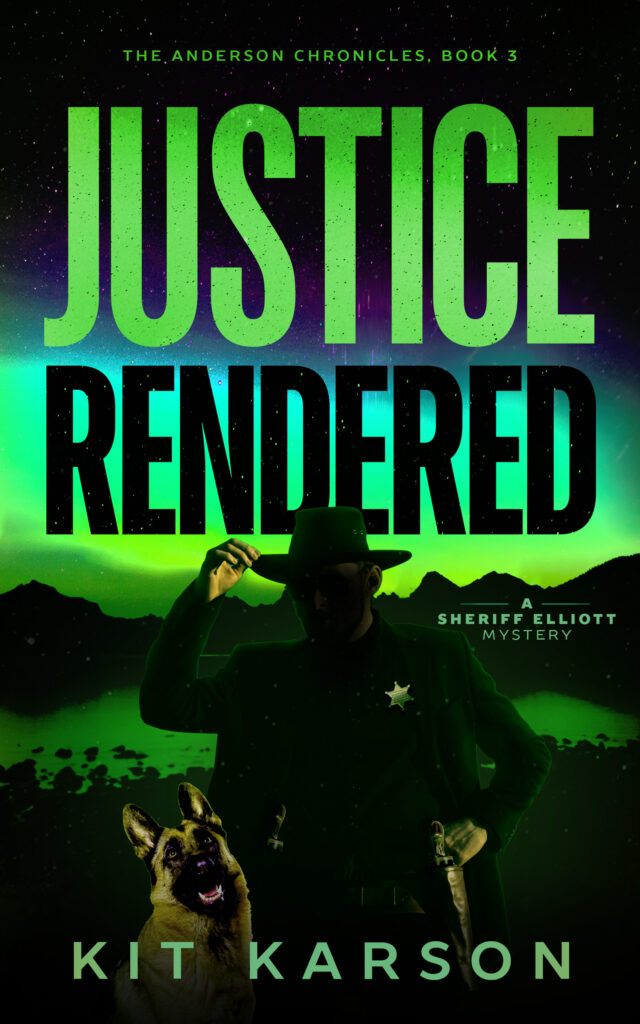
Sheriff Peter Elliot sat high above town on his front porch swing, listening as the hum of vehicles and voices faded, replaced with breeze-rustled leaves and an occasional yipping dog. At times like these, in the deep quiet of the night, Peter would pause the creaking of his swing and listen closely. Echoes from a time gone by flowed from the accumulated dust of eroded granite that made up the rough earthen streets of Anderson, Montana. Muffled rattles of wagon wheels and cracking whips blended with neighing horses and the clang of a blacksmith’s hammer. Such was life in the original settlement, an outpost of the vast Anderson Ranch. Among locals it was acknowledged that the small town of Anderson, deep in the center of Stone County, Montana, carried an unexplainable aura of enchantment.
Peter woke cold and stiff, the pattern of the porch swing cushion etched into his cheek and his mahogany hair more unruly than usual. A hot shower loosened his joints and a vigorous walk in the crisp morning air cleared the fog from his brain. Late summer rains rutted the dirt road leading from Peter’s cozy bungalow to Anderson’s stately brick and granite courthouse. Peter carefully traversed the rough road while his German Shepherd, Zack, trained police dog and faithful friend, jogged by his side, stopping now and then to sniff under a bush.
In the second-floor sheriff’s department, Peter found his deputies gathered around a white bakery box, engaged in their morning ritual of donuts and updates.
Crumbs dusted Deputy Helen’s uniform shirt and filtered through cracks between buttons and straining fabric. She kept her hair in a honey-highlighted bob rather than the long gray braid from past years but was losing the battle with her weight. Complacency brought on by contentment kept her dipping into the donut box.
“Huckleberries are ripe,” she said. “I saved you a jelly-filled.”
“Thanks,” said Peter, pulling up a chair and picking the last huckleberry donut out of the box. He broke off a piece and tossed it to Zack. “Anything exciting happening?”
“It’s quiet even for Anderson,” replied Travis, blond and buff office clerk, and forensic enthusiast. “Not a single drunken fight or domestic call last night.”
“Good. Where’s Angus?”
“Out on a complaint. The perpetual garage sale is oozing onto the sidewalk again.”
Peter rolled his eyes. “Does it seem to you he collects more stuff than he sells?”
“My theory is Fred ran out of room in his own house and bought an empty lot for expansion,” said Helen.
“I’ll go give Angus a hand.” Peter grabbed a chocolate-frosted and whistled for Zack. “Fred could argue the teats off a milk cow.”
“You forgot your hat,” said Travis.
Peter found folks expected a western sheriff to dress the part, and responded accordingly. That and his six-foot-five, two-hundred-pound frame lent authority to his position. He lifted his required Stetson off the rack and tapped it firmly into place with only a minuscule smudge of chocolate on the brim.
The closest route to Main Street and the perpetual garage sale was through the hidden exit in Peter’s office and that’s the way he chose to go. In the late 1800s, when the courthouse was being built, the sitting sheriff made a special request for the secret doorway. He could think of no better way to avoid angry citizens and pesky reporters. Peter appreciated the shortcut. A brief walk down a steep hill and across the street brought him to the one blemish in an otherwise pretty place.
Angus’s face was almost as red as his hair, his tightly wound wiry frame on the verge of erupting. Fred’s enormous sweatpants-clad bottom was stuffed in a recliner in the middle of the boardwalk, and he remained unmoved as did the hodgepodge cluttered around him. An end table filled with empty pop cans and snack bags sat next to the chair.
“Hey, Fred,” said Peter, aware of the relief on Angus’s face at the sound of reinforcement.
“Sheriff. Good to see you. Are you looking for anything in particular? I’m holding back a few special items for exclusive customers.”
“No, Fred. I’m not shopping. Do you have a license to hold a sidewalk sale?”
Fred scratched a large mole on his chin, pursed his thick lips, and considered. “Well, no, I don’t believe I do.”
With a wide-mouthed smirk, he pulled a folded sheet of paper, smudged and torn, from his faded plaid shirt pocket. Making a show of smoothing the wrinkles, clearing his throat, and flicking a long tongue, he read:
“City ordinance five-two dash four. Retail businesses are permitted to use the area in front of their stores in the process of conducting business.” He folded the paper and returned it to his pocket.
“You’re missing a few important points.”
“And what would those be, Sheriff?”
“You know perfectly well you don’t have a retail business license. You have a special ‘garage sale’ permit. Even if you did have the proper license, you would be in violation.”
Fred’s smug smirk visibly sagged.
“The ordinance states there must be at least five feet of walking space between displays of merchandise and the roadway. You’ve taken up the entire boardwalk. People are walking in the street to get around you and your mess.”
Fred eyed a group of tourists giving him dirty looks as they stepped into the gutter. Few suspected decaying concrete sidewalks were hidden beneath the weathered wooden boardwalks, or that the colorful paint adorning late Victorian era houses dressed in towers and turrets was anything but original. Visitors came to immerse themselves in the romance of another era and Fred’s overflowing lot of modern-day trash marred the illusion.
“If you continue reading the ordinance, you will also note that sale items may only be displayed between the hours of eight a.m. and five p.m. According to the complaint our office received, you’ve had your junk sitting out here night and day for an entire week.”
Fred’s large face puffed in irritation. “This is pure discrimination, Sheriff. I intend to file a harassment complaint.”
“You can do that when you come to the courthouse to pay your fine. Write him a ticket, Angus.”
Fred bristled. “A ticket for what!”
“Public nuisance. That’s up to five hundred dollars and/or six months in jail. You’d better hope Judge Knowles is having a good day.”
Angus flipped the cover on his ticket book, arranged the pages, and clicked open his pen. “How do you spell your last name, Fred?”
Fred crossed his arms and huffed.
“We could charge you with refusing to comply with a police officer,” said Peter.
“F. I. L. M. O. R. E.”
“Filmore?” clarified Angus, as he wrote the letters.
“Yeah.”
Angus finished filling out the ticket and laid it on the cluttered end table after Fred refused to take it.
“The ticket is valid whether you take it out of the officer’s hand or not, Fred,” said Peter.
He turned back as he and Angus were walking away. “We’ll be back at five oh one. If this boardwalk isn’t cleared, you’ll get another citation.”